

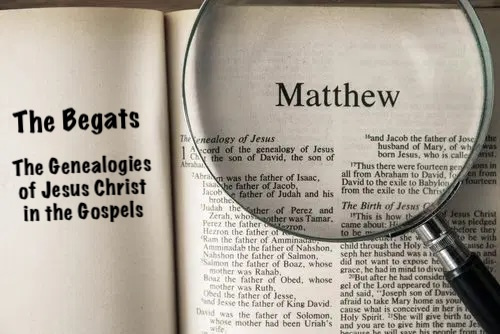
 We are tempted to skip over Scripture’s genealogies; after all, reading through them can be long and laborious. They are not only packed full of names impossible to pronounce, but many of the people to whom these unpronounceable names belong we know nothing about. Still, we should never skip over anything in Scripture, because everything in the Bible is significant and important. If it wasn’t, it wouldn’t be in the Bible; God would not have put it in His Word. Therefore, we can ill afford to skip over anything the sacred Scripture has to say.
The story is told of a Sunday School teacher who once asked a class of small children what was their favorite part of the Bible. A little girl quickly answered, “The begats!” The two genealogies of Jesus Christ, found in Matthew 1:1-17 and Luke 3:23-38, are not only of tremendous importance, but also loaded with light and a ton of truth. In fact, if you will take the time to seriously study them, they just may become your favorite part of the Bible.
The two genealogies of Jesus Christ, which are found in Matthew 1:1-17 and Luke 3:23-38, differ from one another. First, they differ in direction. Matthew’s genealogy starts with Abraham and goes forward to Christ. Luke’s genealogy, on the other hand, starts with Christ and goes backward all the way to Adam. Second, they differ in lineages. Whereas Matthew traces the legal lineage of Christ through His foster father Joseph, Luke traces the actual lineage of Christ through His real mother Mary. Luke 3:23, the initial verse of Luke’s genealogy, could be paraphrased: “And Jesus himself began to be about thirty years of age, being (as was supposed) the son of Joseph, but actually a son of Heli (the father of Mary).”
The fact that Mary’s name was not mentioned in Luke’s genealogy is not surprising, since the names of women were not used in official genealogies. However, what is surprising is that Matthew’s genealogy of Christ does mention women. Furthermore, and even more flabbergasting, the four women Matthew mentions were all embarrassments to the royal line of Judah. Tamar, who Matthew mentions in verse 1, was guilty of an incestuous relationship (Genesis 38:6-30). Rahab, who Matthew mentions in verse 5, was a harlot (Joshua 2:1-12). Bathsheba, who Matthew mentions in verse 6, was an adulteress (2 Samuel 11:1-27). And even the virtuous Ruth, who Matthew also mentions in verse 5, was a Moabitess, whose origins were incestuous (Genesis 19:30-37). In addition, all four of these women were Gentiles. Tamar, Rahab, and Ruth undoubtedly so, and Bathsheba probably so, but treated as a Gentile nonetheless, because of her marriage to Uriah the Hittite.
What at first glance appears to be dumbfounding and inexplicable; namely, the surprising mention of these four women in Matthew’s genealogy of Christ, is actually a brilliant stroke of divine inspiration. By including these women in Christ’s genealogy the Holy Spirit painted for us a masterpiece of God’s grace, by showing us how Christ came for both the fallen and the foreigner. Here, we are shown how the amazing grace of God in Christ can completely redeem the most notorious sinners and strangers, so that they can be used in the most magnificent way to bring Christ to the world and God’s eternal plans and purposes to pass.
With the exception of a few notable names and notorious sinners, we know little or nothing about most of those appearing in Matthew’s and Luke’s genealogies of Christ. We must conclude, therefore, that most were just common people like you and me. Of course, this is in perfect accordance with what the Apostle Paul taught in 1 Corinthians 1:26-29, where we learn that God loves to do extraordinary things through ordinary people. Whereas God occasionally uses the wise, mighty, and noble, like Abraham, David, or Solomon, He normally uses the foolish, weak, and obscure, like Azor, Elihud, or Matthan. While the latter is the rule, the former is the exception.
By tracing the genealogy of Jesus Christ through Mary, instead of through Joseph, and all the way back to Adam, Luke shows us that Jesus Christ was both the Son of God and the Son of Man. As the Son of the virgin Mary, Jesus Christ was fully God. As the Son of Adam, Jesus Christ was fully man. He was and is very God and very man; the one and only God-Man.
Luke’s genealogy of Christ also shows the virgin born Jesus to be the long awaited and promised seed of the woman. He is the fulfillment of the Bible’s first Messianic prophecy, which is known as the “protoevangelium”—the first preaching of the Gospel or of the Good News in all of Scripture (Genesis 3:15). From this point forward the whole Bible is employed in expounding upon this extraordinary promise, as well as its eventual fulfillment in the coming of Christ. For this reason, this verse is called “the Bible in embryo,” the “sum of history” (His story), and “the germ of all prophecy that unfolds into the perfect, fragrant bloom of the Rose of Sharon and the Lily of the Valley.”
As the protoevangelium predicted, the coming of Christ resulted in His heel being bruised by the serpent and in the serpent’s head being crushed by Christ. In the crucifixion, Satan bruised Christ’s heel, but in the resurrection, Christ delivered a fatal blow to Satan’s head. By doing so, Christ restored to fallen humanity everything forfeited by Adam in the Fall. Therefore, the first Adam was “a son of God”—the first man of God’s creation—but the Last Adam, Jesus Christ, was “the Son of God”—the first man of God’s new creation.
In a far more subtle way, Matthew also alludes to this parallel between Adam and Christ. Matthew’s expression in verse 1, “The book of the generation of Jesus Christ,” is only found elsewhere in Scripture in Genesis 5:1, where we read, “The book of the generation of Adam.” This parallel between Jesus and Adam, subtly alluded to by Matthew, is elaborated on and expounded by the Apostle Paul in Romans 5:12-21 and 1 Corinthians 15:45-49. According to Paul, the first Adam was created, but the Last Adam was the Creator. The first Adam made us sinners through his disobedience, but the Last Adam made us righteous through His obedience. The first Adam became a living soul, but the Last Adam a life-giving Spirit. The first Adam was from the earth, but the Last Adam was the Lord from Heaven. And the first Adam’s image is borne by us today, but the Last Adam’s image shall be borne by us tomorrow.
Along with being the Son of God and the Son of Adam, Jesus Christ is also the Son of David and the Son of Abraham. Whether through the line of His legal foster father Joseph, as recorded by Matthew, or through the line of His real mother Mary, as recorded by Luke, Jesus is a descendant of both David and Abraham. Therefore, Matthew declares Jesus to be “the son of David, the son of Abraham” (verse 1).
As the Son of David, Jesus is heir to the throne. God promised David that one of his descendants would reign on his throne forever (Isaiah 9:7). That promised descendant of David is none other than Jesus Christ, who the Angel Gabriel announced to Mary “shall reign over the house of Jacob forever; and of whose kingdom there shall be no end” (Luke 1:32-33).
According to Matthew 1:17, “all the generations from Abraham to David are fourteen generations, and from David until the carrying away into Babylon are fourteen generations, and from the carrying away into Babylon unto Christ are fourteen generations.” Here, we find ourselves confronted with a quandary, since we know that there were more than forty two generations from Abraham to Jesus. For instance, Matthew’s genealogy skips over Kings Ahaziah, Joash, and Amaziah, between Kings Joram and Uzziah. Still, as we will show below, there is not only a perfectly reasonable solution to our quandary, but also some additional great truths to be gleaned from it.
Let’s start with the simple solution to our quandary. Since they did not have books or written records, as we do today, the Jews often divided genealogies into tables of equal numbers to commit them to memory, lest they be lost to posterity. Now that we know why Matthew divided Christ’s genealogy into three equal tables of fourteen generations, let’s turn our attention to the additional truths to be gleaned from it. To begin with, consider the fact that the only way to count out three equal tables of fourteen generations in Matthew’s genealogy of Christ is to count David twice, once at the end of the first table and again at the beginning of the second. However, far from being an oversight, this appears to be most insightful, for a couple of good reasons. First, David is the key ancestor Matthew wished to highlight in his genealogy of Christ. Second, the numerical value of the Hebrew name David is fourteen.
Hebrew letters, at least the consonants, were not just building blocks for words, but also doubled as symbols for numbers. The Hebrew letter or consonant “d” was the symbol for four; and the Hebrew letter or consonant “v” was the symbol for six. Therefore, the consonants in the name David, “dvd,” add up to fourteen.
Another question posed by Matthew’s genealogy of Christ is its inclusion of the name Jeconiah (verses 11-12). According to the Prophet Jeremiah, no descendant of Jeconiah would ever occupy the throne of David (Jeremiah 22:30). How then could Jeconiah be included in Matthew’s genealogy of Christ, who shall forever occupy David’s throne? The answer is found in the fact that Matthew gives us Jesus’ legal lineage through His foster father Joseph, which is traced back to David through Jeconiah, not His actual lineage though His real mother Mary, which, as Luke shows, is traced back to David through Nathan.
Last, but certainly not least, Jesus is not only shown to be the Son of God, the Son of Adam, and the Son of David, through His two genealogies in the Gospels of Matthew and Luke, but He is also shown to to be the Son of Abraham. As the Son of Abraham, Jesus is Abraham’s promised seed and predicted heir to the promise (Galatians 3:16, 26-29). Through faith in Christ, we can all become children of Abraham, the father of the faithful, and heirs of all the promises of God (2 Corinthians 1:20).
A young soldier, who was the only child of a wealthy widower, was tragically killed in war. His father, needless to say, was heartbroken over the loss of his beloved son. Months after receiving the heartbreaking news of his son’s death, the rich father, still in the throes of grief, received an unexpected visitor. A comrade of his late son showed up at the father’s mansion door with a gift, an amateurish portrait painted by the surprise guest of his best friend, the father’s dead boy. The portrait instantly became the father’s priced possession and was prominently hung above the mantel in the mansion’s main room.
Some time later, the wealthy man died, and his elaborate estate was publicly auctioned. People came from all over to bid on the priceless possessions of this fabulously wealthy man’s elaborate estate. However, the public auction surprisingly began with the amateurish portrait of the dead man’s late son, for which the auctioneer failed to receive a single bid. Informing all gathered that the auction could not proceed until someone purchased the portrait, a single low bid was made and accepted. Then, to everyone’s surprise, the auctioneer announced that the auction was concluded. To quiet the immediate and uproarious protest, the auctioneer explained to all who had gathered that the father had put it in his will that whoever got the son got it all. Well, here is a glorious truth gleaned from the two genealogies of Jesus Christ in the Gospels of Matthew and Luke: It is the will of the Heavenly Father that whoever gets His Son gets it all!