 Due to the uselessness, let me repeat that, uselessness, now, one more time, in capital letters, USELESSNESS of Senate Republicans, Trump has been forced to implement, by executive order, his Systematic Alien Verification for Entitlements (SAVE) program. Since Senate Republicans, whose group photo could serve as the poster child for impotence and incompetence, are unwilling to nuke the Senate filibuster and pass the SAVE Act, to protect the integrity of our elections, Trump has implemented by executive order the ability of the Department of Homeland Security to utilize government records, specifically Social Security information, to verify that every voter is an American citizenship. Of course, in protest of Trump's executive order, insane Democrats insanely argue that Trump is trying to rig the midterm elections by verifying that every voter is a legitimate voter and American citizen. Such an absurd argument is tantamount to arguing that safety nets are deathtraps and highway guardrails are road hazards.
As always, Democrats have rushed to the courts to find one lone lunatic with a gavel in his or her hand, so the goofy gavel swinger can usurp the power of the presidency and overrule the President of the United States from his or her little courtroom, which, in his or her demented mind, is hallucinated to be the throne room of the universe. Enter incognizant U.S. District Judge Sparkle Sooknanan, an appointee of cognitively impaired Joe Biden, who insanely struck down Trump’s attempt to verify the legitimacy and citizenry of American voters by irrationally ruling that it was a violation of voters’ right to vote. In other words, this judicial jughead ordered that protecting our elections from fraud prohibits our electorate from voting.
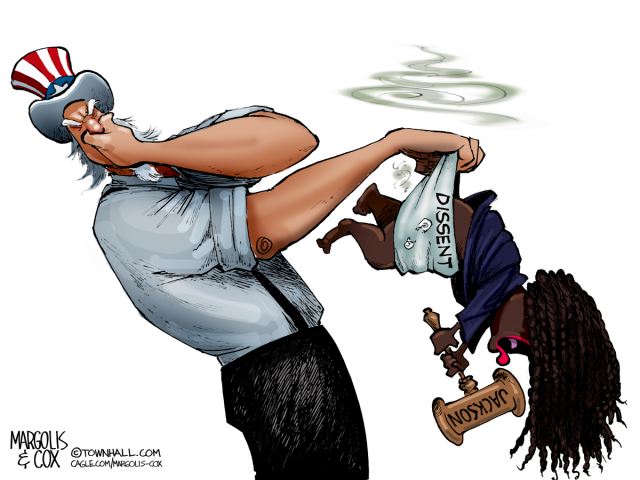
Yesterday, the Supreme Court of the United States inserted a little sanity into the insanity of Sooknanan and Democrats’ crazy contention that protecting our elections from voter fraud forbids valid voters from voting in our elections. In a six to three decision, the Court green lighted Trump’s Systematic Alien Verification for Entitlements (SAVE) program ahead of our upcoming midterm elections. Predictably, the Court’s three left-wing lunatic gavel swingers dissented, arguing, as all dunderheaded Democrats do, that safeguarding our elections is voter suppression. Writing for the dissenters, Justice Ketanji Brown Jackson wrote a dissent that has been dubbed as downright “illusionary”; that is, made-up out of whole cloth. Now, it would be comical to see Ketanji Brown Jackson clad in this clown suit of whole cloth if she was not a Supreme Court Justice, but the fact that she is, makes her making up all of her muttonheaded judicial opinions from her mad mind no laughing matter.

