
This precious Psalm is believed to have been authored by David in his old age. It appears to have been penned when he was weakened by age and wearied by years. It is a plea for God not to forsake us in the frailty and infirmities of old age, but to strengthen us so that we, as seniors, can still serve as effective witnesses, even to our juniors. For this reason, I’ve dubbed this Psalm, which I, as an old geezer myself, can surely sympathize with, “The Old-Timer’s Psalm.”
There is no time in life when the words of Jesus to His sleeping disciples in Gethsemane—“the spirit is willing, but the flesh is weak”—are more apropos than in old age (Matthew 26:41). The spirit of the hoary-headed saint, thanks to years of strengthening in God’s grace (2 Timothy 2:1), should be stronger than ever. However, the fallen body, the hoary-headed saint’s earth suit, in which his or her more than ever willing spirit is housed, is weaker than ever.
In old age, we are forced to face the hard and harsh fact that we can no longer do what we once did, as well as few things, if any, as well as we use to do them. Although our spirit, more than ever before, longs to soar celestially, our flesh, more than ever before, limits us to stumbling around terrestrially. Truly, there is no time in life when we need to pray more for God’s strengthening than in our old age, as David did, lest we become, as David feared he would, an old worn-out witness no longer instrumental to God nor influential in the world.
Martin Luther said, “It would be a good thing if young people were wise and old people were strong.” I too have wondered why we have so much strength to exert in the witlessness of our youth, but so little left to employ in the wisdom of our old age. Nevertheless, let us pray, like David, for sufficient strength to live out our twilight years smarter and shrewder, since we can ill afford to waste our scanty strength and short time on superficial things.
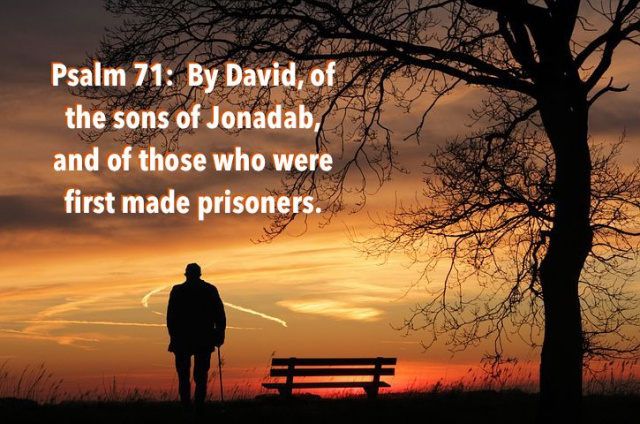 The “Old-Timer’s Psalm,” as I’ve affectionately dubbed Psalm 71, has no title in the Hebrew text. However, in the Greek Septuagint and Latin Vulgate, it is titled: “By David, of the sons of Jonadab, and of those who were first made prisoners.” This Title suggest two intriguing theories.
First, some argue that David wrote this Psalm prophetically, foreseeing the future plight of the Rechabites, the sons or descendants of Jonadab (Jeremiah 35:1-19). The Rechabites stood out among the people of God in the days of Jeremiah as uncompromising stalwarts, who refused to renege on their vow to their father. As a result of their faithfulness, God promised to spare them from the sword of Nebuchadrezzar, by having them included among the chosen Jewish captives of the Babylonian Captivity. Though their captivity was long, their survivors returned among the returning Jewish captives to their beloved Jerusalem. All in all, the story of the Rechabites is an inspiring tale of divine providence and of God’s providential protection and preservation of His faithful people, even in the most perilous of times.
The possibility that this Psalm is a foreshadowing of the plight of the Rechabites, in their old age, during the Babylonian Captivity, has led others to propose that it may also be a mystical and prophetic foreshadowing of the church, in her old age, during the perilous times of the last days (2 Timothy 3:1). Weakened by years of carnality and apostasy, God will purify His church by the fiery trials of end-time tribulation and strengthen her by His grace in the throes of unprecedented persecution, so that she will once again rise up faithfully as a formidable force for Christ upon a fallen planet swiftly running out of time.
Regardless of the fact that these two theories derived from the Psalm’s title in the Greek Septuagint and Latin Vulgate are merely plausible and not actually provable, we can rest assured, thanks to this Psalm, as well as many other scriptural passages, that God will never forsake His faithful people in their old age, in trying times, or even at the end of time. Remember, Christ has promised to never leave us nor forsake us, but to be with us always, even unto the end of the world (Hebrews 13:5; Matthew 28:20)!

