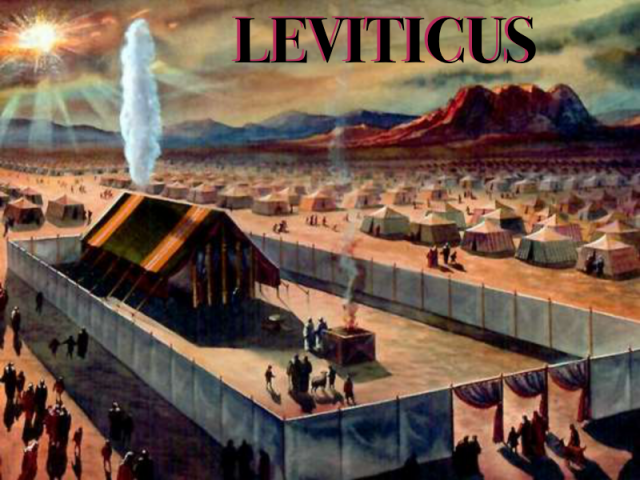
 Introduction: Leviticus is a book of laws for Israel’s Levitical priesthood. It was the first book to be studied by Jewish children, but often among the last books to be studied by today’s Christians, despite its obvious importance, which is proven by the fact that it is quoted about forty times in the New Testament. Much of its spiritual significance and importance, as well as its seeming inscrutability, is found in the typology of its manifold sacrifices.
Leviticus 1:1 — Leviticus is a sequel to Exodus, which concludes with the construction of the tabernacle. With the tabernacle constructed, its sacrifices could commence. Therefore, God speaks His sacrificial laws from the tabernacle to Moses at the foot of Mount Sinai.
In this opening verse, we have a summary of the book of Leviticus. It is the laws for Israel’s sacrificial system and Levitical priesthood that were given by God to Moses at the newly constructed tabernacle, which first stood at the foot of Mount Sinai.
Leviticus 1:2 — The covenant God made with Israel at Mount Sinai not only gave Israel the law they had to obey to be faithful to God, but also the sacrifices they had to offer to be forgiven by God, whenever God’s law was broken.
Israel’s sacrifices had to be offered to the Lord and from their own flocks and herds. In other words, their sacrifices had to be expensive to them and exclusively offered to the Lord; otherwise, they would be an offense to God rather than an oblation.
Leviticus 1:3 — If our worship is to be acceptable to the Lord, we must wholly and freely offer Him our best, as is symbolized here in the burnt offering, which had to be the best of one’s flock or herd and freely given to be completely consumed on the altar of the tabernacle.
Not only did burnt offerings have to be without blemish or defect to atone for the sins of defective sinners, but also to symbolize the sinless Christ, who was to come as the unblemished Lamb of God to take away the sin of the world. (John 1:29; 1 Peter 1:18-20)
Leviticus 1:4a — For the burnt offering to atone for sin, the sinner had to identify with it by laying his hands upon its head. In doing so, the sinner publicly confessed his sin and totally committed himself to God as well.
In order for Christ to atone for our sin, we must identify with Him, by personally taking hold of Him by faith as our Savior and by publicly confessing our sin and totally committing ourself to Him.
Leviticus 1:4b — Whereas the atonement of repeated and unblemished animal sacrifices, at the Old Testament’s tabernacle and temple, temporarily covered sin, the atonement of the sinless Christ, sacrificed once and for all upon the cross of Calvary, forever removes sin. (John 1:29; Hebrews 7:26-28; 9:11-14)
The Hebrew word “kipper,” which means “to make atonement,” is used almost fifty times in Leviticus, as well as about fifty times in the rest of the Old Testament. Is there any wonder, then, that Leviticus, because of all of the sacrificial blood that runs through it, has been called the reddest book in the Bible?
Leviticus 1:5 — Since the wages of sin is death, the sacrifice, to be substitutionary, not only had to die, but its blood had to be shed and sprinkled; otherwise, the sinner could not be pardoned, because his penalty was unpaid. (Romans 6:23)
Since the wages of sin is death and life is in the blood, there can be no remission or forgiveness of sin without the shedding of blood. For every sin ever committed someone’s life must be poured out and someone’s blood must be shed, for a just God will see to it that no sin goes unpunished, since He knows that there can be no justice without judgment. Therefore, in the Old Testament, the corruptible blood of animals was shed in place of the blood of sinners, so that sinners could be temporarily forgiven, but in the New Testament, the imperishable blood of Christ was shed in place of the blood of sinners, so that sinners can be forever forgiven. (Romans 6:23; Leviticus 17:11; Hebrews 9:22; Romans 3:21-26; 1 Peter 1:18-19)
WHAT CAN WASH AWAY MY SINS (Robert Lowry)
What can wash away my sin?
Nothing but the blood of Jesus.
What can make me whole again?
Nothing but the blood of Jesus.
For my pardon this I see,
Nothing but the blood of Jesus.
For my cleansing this my plea,
Nothing but the blood of Jesus.
Nothing can for sin atone,
Nothing but the blood of Jesus
Not of good that I have done,
Nothing but the blood of Jesus
This is all my hope and peace,
Nothing but the blood of Jesus.
This is all my righteousness,
Nothing but the blood of Jesus
O precious is the flow
That makes me white as snow.
No other fount I know
Nothing but the blood of Jesus.
Leviticus 1:6-9 — The offering of the atoning sacrifice and the surrendering of all to God were a sweet smelling aroma unto the Lord.
According to the Apostle Paul, Christ loving sacrifice and surrender of His all for us, as atonement for our sins, was the sweetest smelling aroma unto the Lord of all time! (Ephesians 5:2)
Leviticus 1:10-13 — Having given us the procedure for offering a bull as a burnt offering, Leviticus now gives us the procedure for offering a lamb or a goat as a burnt offering.
Again, as in verses 3-9, if the sacrifice is to prove to be a sweet smelling aroma to God, it not only had to be all offered for atonement, but also offered as God specifically prescribed and only by God’s sanctified priests. It could not be offered for just anything, in any proportion, in any way, and by anybody.
Leviticus 1:14-17 — Here we have the procedure for offering birds, specifically turtledoves or young pigeons, as burnt offerings. Obviously, the poor, who had neither flocks nor herds, could at least offer a fowl to atone for their sin.
That God would accept a turtledove, not just a bull or a sheep, shows that He was most concerned with a penitent heart, not the particular kind of animal being sacrificed. If the poor were unable to do any better or to give any more than a pigeon, their burnt offering was still a sweet smelling aroma to God, as long as their heart was sincerely penitent. On the other hand, if one could do better or give more, but still chose to just offer a pigeon, his sacrifice would be a stench in the nostrils of God.
Leviticus 2:1-10 —The symbolism of the grain offering teaches us that if what we produce (fine flour) is to be pleasing to God and preserved by God (salt), it must be incorruptible, (unleavened), Spirit anointed (oil), and offered prayerfully (frankincense).(HCSB)
The holiest part of the grain offering was the bread it provided, of which the Levitical priesthood alone freely partook. This symbolized the offering of Christ—the Bread of Life—on the cross of Calvary, of which the priesthood of believers alone have freely partaken. (1 Peter 2:5)
Leviticus 3:1-17 — The fellowship offering was not obligatory, but voluntary, offered by those most desirous of fellowship with God. It was only required of the Nazarite, who vowed extraordinary consecration to God, in order to know uncommon communion with God. (Numbers 6:17)
That few today desire closer fellowship with God is proven by the dearth of voluntary offerings to God. Furthermore, Nazarites are almost nonexistent, since few contemporary Christians are willing to be extraordinarily consecrated to God so that they can know uncommon communion with God.
Leviticus 8:22-30 — To consecrate God's anointed priests the atoning blood was applied to the earlobes of their right ears, thumbs of their right hands, and big toes of their right feet, for God’s representatives must be careful about what they hear, what they do, and where they go.
God's priests are consecrated—set apart—to hear God's Word, to do God's work, and to walk in God's ways!
Leviticus 9:24 — Wherever the fire of God falls, there will be reverence, not revelry. Men will not frivolously party all around, but fall prostrate on the ground.
"Only when we are captured by an overwhelming sense of awe and reverence in the presence of God, will we begin to worship God in Spirit and truth." (Alistair Begg)
Leviticus 10:1-7 — Those who shun the fire of God’s glory, supposing that strange fire of their own making is every bit as good, are in danger of being interred in their religious attire.
It is strange fire rather than divine fire that burns on the altar of many a Christian heart and church house today. It is fire of our own making ignited for our own glory rather than holy fire that has fallen from Heaven for the glory of God.
Much that passes for Spirit-empowered Christianity today is nothing more than our carnal flesh on parade.
Leviticus 17:11 — Since life is in the blood and the wages of sin is death, the only hope of our sin debt ever being pardoned or our sins forgiven was for Christ to pay for our sins by shedding His blood in place of ours on the cross of Calvary. (Leviticus 17:11; Romans 6:23; Hebrews 9:22)
For every sin that has ever been committed someone must die; that is, someone’s lifeblood must be shed. Therefore, there is no hope for the salvation of sinners apart from Christ dying in their place and shedding His lifeblood as a substitute for theirs.
NOTHING BUT THE BLOOD OF JESUS (Robert Lowery)
What can wash away my sin?
Nothing but the blood of Jesus;
What can make me whole again?
Nothing but the blood of Jesus.
For my pardon this I see
Nothing but the blood of Jesus!
For my cleansing this my plea
Nothing but the blood of Jesus!
Nothing can my sin erase
Nothing but the blood of Jesus!
Naught of works, 'tis all of grace
Nothing but the blood of Jesus!
This is all my hope and peace
Nothing but the blood of Jesus!
This is all my righteousness
Nothing but the blood of Jesus!
Oh! precious is the flow
That makes me white as snow;
No other fount I know,
Nothing but the blood of Jesus.
Leviticus 19:15 — The perverting of justice by partiality is prohibited by God. Likewise, God forbids the forfeiting of fairness over favoritism.
"Injustice anywhere is a threat to justice everywhere." (Martin Luther King Jr.)
Leviticus 22:29 — To be gratifying to God, thanksgiving must be offered genuinely, never grudgingly.
“He who thanks but with the lips, thanks but in part. The full, the true thanksgiving, comes from the heart.” (J.A. Shedd)
BACK TO TWEETS BY THE BOOKS

