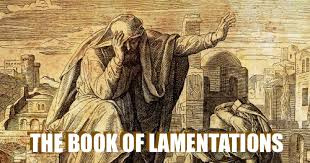
Introduction: The five chapters of Lamentations are five dirges or funeral songs written by the Prophet Jeremiah in his lamentation over the destruction of his beloved city, Jerusalem. Chapters 1, 2, 3, and 4 are arranged in an acrostic pattern. The twenty-two verses of chapters 1, 2, and 4 begin with the consecutive letters of the Hebrew alphabet. However, chapter 3, which contains sixty-six verses rather than twenty-two, is written in a triple acrostic pattern, with each consecutive three verses beginning with a consecutive letter of the Hebrew alphabet. Chapter 5, unlike the rest of the book, is not written in an acrostic pattern, despite containing twenty-two verses, just like chapters 1, 2, and 4.
Lamentations gets its name from the first word in its first verse, which in Hebrew means “laments” or “dirges.” Interestingly, it can also be translated, “how,” which was undoubtedly the question asked when the people of God were slain and enslaved, the city of God sieged and conquered, and the temple of God burned down and destroyed by Nebuchadnezzar, the King of Babylon.
The parallels between Deuteronomy 28 and Lamentations appear to have answered the question of how. The curses enumerated in Deuteronomy 28, which God forewarned His people would inevitably befall them if they ever rebelled against Him, are the very things Jeremiah describes in Lamentations as having happened to a rebellious Judah and a God-forsaking Jerusalem. The moral of this story is clear, there is no such thing as security in sin, neither for temple attending Jews in Jerusalem in Jeremiah’s day nor for churchgoing Christians in America in our day. As Scripture forewarns us all, “Be sure your sin will find you out” and “Be not deceived; God is not mocked: for whatsoever a man soweth, that shall he also reap” (Numbers 32:23; Galatians 6:7).
PARALLELS BETWEEN DEUTERONOMY 28 AND LAMENTATIONS
|
“Judah is gone into captivity…she dwelleth among the heathen, she findeth no rest.” (Lamentations 1:3)
|
“And the Lord shall scatter thee among all people…And among these nations shalt thou find no ease, neither shall the sole of thy foot have rest.” (Deuteronomy 28:64-65
|
|
“Her adversaries are the chief…” (Lamentations 1:5)
|
“The stranger that is within thee shall get up above thee very high; and thou shalt come down very low…he shall be the head, and thou shalt be the tail.” (Deuteronomy 28:44)
|
|
“…her children are gone into captivity before the enemy.” (Lamentations 1:5)
|
“Thy sons and thy daughters shall be given unto another people, and thine eyes shall look, and fail with longing for them all the day long…” (Deuteronomy 28:32)
|
|
“…they are gone without strength before the pursuer.” (Lamentations 1:6)
|
“The Lord shall cause thee to be smitten before thine enemies: thou shalt go out one way against them, and flee seven ways before them…” (Deuteronomy 28:25)
|
|
“…my virgins and my young men are gone into captivity.” (Lamentations 1:18)
|
“Thou shalt beget sons and daughters, but thou shalt not enjoy them; for they shall go into captivity.” (Deuteronomy 28:41)
|
|
“All that pass by clap their hands at thee; they hiss and wag their head at the daughter of Jerusalem, saying, Is this the city that men call The perfection of beauty, The joy of the whole earth?’” (Lamentations 2:15)
|
“And thou shalt become an astonishment, a proverb, and a byword, among all nations whither the Lord shall lead thee.” (Deuteronomy 28:37)
|
|
“Shall the women eat their fruit, and children of a span long?” (Lamentations 2:20)
|
“And thou shalt eat the fruit of thine own body, the flesh of thy sons and of thy daughters, which the Lord thy God hath given thee, in the siege, and in the straitness, wherewith thine enemies shall distress thee.” (Deuteronomy 28:53)
|
|
“The young and the old lie on the ground in the streets…” (Lamentations 2:21)
|
“A nation of fierce countenance, which shall not regard the person of the old, nor shew favour to the young.” (Deuteronomy 28:50)
|
|
“The hands of the pitiful women have sodden their own children: they were their meat in the destruction of the daughter of my people.” (Lamentations 4:10)
|
“The tender and delicate woman among you, which would not adventure to set the sole of her foot upon the ground for delicateness and tenderness, her eye shall be evil toward the husband of her bosom, and toward her son, and toward her daughter, And toward her young one that cometh out from between her feet, and toward her children which she shall bear: for she shall eat them for want of all things secretly in the siege and straitness, wherewith thine enemy shall distress thee in thy gates.” (Deuteronomy 28:56-57)
|
|
“Our inheritance is turned to strangers, our houses to aliens.” (Lamentations 5:2)
|
“…thou shalt build an house, and thou shalt not dwell therein…” (Deuteronomy 28:30)
|
|
“Our necks are under persecution: we labour, and have no rest.” (Lamentations 5:5)
|
“And among these nations shalt thou find no ease, neither shall the sole of thy foot have rest…” (Deuteronomy 28:65)
|
|
“Our skin was black like an oven because of the terrible famine.” (Lamentations 5:10)
|
"Therefore shalt thou serve thine enemies which the Lord shall send against thee, in hunger, and in thirst, and in nakedness, and in want of all things…” (Deuteronomy 28:48)
|
|
“They ravished the women in Zion, and the maids in the cities of Judah.” (Lamentations 5:11)
|
“Thou shalt betroth a wife, and another man shall lie with her…” (Deuteronomy 28:30)
|
|
“…the faces of elders were not honoured.” (Lamentations 5:11)
|
“A nation of fierce countenance, which shall not regard the person of the old…” (Deuteronomy 28:50)
|
|
"Because of the mountain of Zion, which is desolate, the foxes walk upon it.” (Lamentations 5:18)
|
“And thy carcase shall be meat unto all fowls of the air, and unto the beasts of the earth, and no man shall fray them away.” (Deuteronomy 28:26)
|
I believe one final note of introduction to Lamentations is warranted. According to Matthew 16:13-14, some believed at the time of Christ that He was Jeremiah come back from the dead. There are similarities between the two, which do not excuse, but may help explain, why some confused Jesus with Jeremiah.
- Jeremiah was known as the weeping prophet and Jesus as “a man of sorrows.” (Isaiah 53:5; Jeremiah 9:1; Lamentations 1:16)
- Both Jeremiah and Jesus predicted the coming judgment of God and destruction of Jerusalem to their unbelieving countrymen. Jeremiah predicted the destruction of Jerusalem by Nebuchadnezzar and the Babylonians in 586 B.C. and Jesus predicted the destruction of Jerusalem by Titus and the Romans in 70 A.D.
- Both Jeremiah and Jesus wept over Jerusalem. Jeremiah in Lamentations and Jesus in Luke 19:41-44.
- Finally, and most strikingly, both Jeremiah and Jesus experienced their greatest anguish on Golgotha, where Jesus was crucified and where Jeremiah, from a grotto on the side of Golgotha, which overlooked Jerusalem’s ruins, is believed to have written the book of Lamentations.
Lamentations 1:1 — Jeremiah mournfully marvels over Jerusalem’s desertion, having gone from being populated to being evacuated, as well as over Jerusalem’s denigration, having gone from being acclaimed to being abased.
Sin always takes us farther than we intended to go, keeps us longer than we intended to stay, and cost us more than we intended to pay.
Lamentations 1:2 — Jerusalem had forsaken her only true friend—Jehovah—for false friends—false gods and foreign alliances. Consequently, there was no one to comfort her in the day of her calamity.
When we forsake our faithful God to befriend this fallen world, we’ll not only end up forsaken by the God we’ve forsaken, but also by the fallen world we’ve befriended.
Lamentations 1:3-6 — Jeremiah now cuts to the chase, the crux and core of the matter; Judah, along with its capital Jerusalem, had been conquered and captured, because of a multitude of transgressions.
It was unrestrained, unrelenting, and unrepentant sin that stopped all the pilgrimages to Jerusalem, the celebrations of all of Jerusalem’s feast, the crowds from coming and going through Jerusalem’s gates, and all of the sacrifices from being offered at Jerusalem’s temple. Likewise, it is sin that has stopped crowds of people from coming to church today to spiritually worship God by offering themselves to Him as living sacrifices. (Romans 12:1 ESV)
Lamentations 1:7 — Once we find ourselves in the hand of our enemy, suffering misery and mockery, we will fondly remember when we were in the hand of our God, being shown mercy.
To exchange our glory—our God—for our shame—our sin—always results in us being ruined and ridiculed rather than rescued and respected.
Lamentations 1:8-9a — Suddenly gone, over her grievous sins, Jerusalem had been discarded like a menstruous and immodest harlot, whose former lovers now loathed and forsook her.
Like Jerusalem, all who delight in the immediate pleasures of sin fail to consider not only sin’s eventual and inescapable consequences, but also their own inevitable end.
Lamentations 1:9b-11 — The triumphant enemy had not only dispossessed Jerusalem of all of her pleasant things, but also left her defiled, her temple desecrated, and her people desolate.
When God’s protective hand is removed from us, because of our sin, we will find ourselves handed over to Satan, who will be used by God to either judge or chasten us as the Chaldeans were used by God to judge and destroy Jerusalem; see Habakkuk 1:5-7 and Acts 13:40-41, as well as 1 Corinthians 5:5 and 1 Timothy 1:19-20.
Lamentations 1:12 — Jeremiah’s sorrow, which passersby were indifferent to, but he himself found both incomparable and incomprehensible, was inflicted upon him by the fierce anger of God, not by the fierce army of Nebuchadnezzar.
Both Jeremiah and Jerusalem knew that the source of their sorrow was not the Babylonians, but God, who had merely used the Babylonians to inflict Jerusalem for her iniquity.
Lamentations 1:13 — Jeremiah likens God’s judgment of Jerusalem not only to an inescapable fire, which is imbedded and burns in one’s bones, but also to an inescapable net, in which one faints from futilely attempting to free oneself.
Make no mistake about it; for the unrepentant and unredeemed sinner, the fiery indignation of God is inextinguishable, and incarceration in a forever inferno is inescapable. (Hebrews 10:26-31; Revelation 20:11-15)
Lamentations 1:14 — Jeremiah likens God’s judgment of Jerusalem to an unbearable yoke to which Jerusalem had been tied with unbreakable ropes, and under which Jerusalem could no longer rise, since she had been utterly crushed beneath the yoke’s cumbersome burden.
While Christ yoke is easy and His burden is light to all who receive Him, the yoke of God’s judgment is hard and heavy to all who reject Him. (Matthew 11:28-30)
Lamentations 1:15 — Jeremiah likens God’s judgement of Jerusalem to a winepress, in which God had trampled her in His wrath for her transgressions.
Jerusalem’s sins had fully ripened; therefore, God cast her into the winepress of His wrath to trample her beneath His feet.
Lamentations 1:16-17 — Once again; see verses 8-9, Jeremiah likens God’s judgement of Jerusalem to the discarding of a menstruous and immodest harlot, whose former lovers and flatterers had all forsaken her.
Having forsaken her faithful Lord, for the flattery of her false lovers, Jerusalem found herself without the Lord, the Comforter of men’s souls, and surrounded by foes, who formerly feigned to be her friends, but who now, in her calamity, were no comfort to her at all.
Lamentations 1:18a — Jerusalem was not the helpless prey of cruel fate, but the intended object of God’s wrath and intended target of God’s judgment.
God was right to deal out to Jerusalem her just deserts for all of her willful wrongdoing, just as He is right today to deal out to us our just deserts for all of our willful wrongdoing.
Lamentations 1:18b — The captivity of Jerusalem’s children was an inevitable consequence of Jerusalem’s rebellion against God’s commandments.
Not only is the younger generation always taken captive by the world when the older generation is insubordinate to God’s Word, but the church is always infiltrated by the world when it fails to indoctrinate its children in God’s Word.
Lamentations 1:19 — Like the prodigal son, Jerusalem also found itself starving without any assistance from its false friends, who had formerly befriended it and frolicked with it in riotous living. (Luke 15:13-16)
This fallen world is a false friend, while it will feign to be your friend as long as it finds you useful, it will throw you away like last week’s magazine the moment it finds you useless, which definitely makes it even more indefensible for you to forsake God, who is always faithful and will never forsake you, for this fallen world, which is never faithful and will always forsake you.
Lamentations 1:20a — Jerusalem was most grieved, not over her calamity, but over its cause; namely, her grievous sins against God.
What makes calamity most grievous is when it is self-induced; that is, when we know we’ve brought it upon ourselves.
Lamentations 1:20b — Again, we are shown how God’s judgment is inescapable. If Jerusalem’s inhabitants had tried to flee from it, they would have been cut down by the sword in the street, but if they tried to hide from it in their homes, they would have starved to death.
If fallen angels, the prediluvian world, Sodom and Gomorrah, and God’s own chosen people, in the wilderness, as well as in Jerusalem, could not escape God’s judgment, what makes you think you can? (Jude 1:5-7; 2 Peter 2:4-7)
Lamentations 1:21-22 — Jeremiah prays for God to judge Jerusalem’s enemies for their sins, just as He had judged Jerusalem for her sins. After all, Jerusalem’s enemies not only callously conquered her, but afterward conceitedly crow over her.
Although all will be judged by God and none will escape God’s judgement, God’s judgment always begins with His own. As it started in Jeremiah’s day with Jerusalem, the city of God, it will begin in our day with the church, the house of God. (1 Peter 4:17)
Lamentations 2:1-5 — When God’s people turn from Him in their waywardness, He will turn on them in His wrath. There is no such thing as security in sin, neither for the sinner, who will be condemned, nor for the saint, who will be chastened.
A Christian profession is not a permission slip to sin; to believe so belies one's profession.
Lamentations 3:1-33 — A sovereign God sends us sufferings to teach us solitude, silence, stillness, and submission. It is truly tragic that God has to so afflict us as to lay us in the dust, in order to get us to finally surrender ourselves into His arms.
Lamentations 3:25-26 — Divine Deliverance comes to those who quietly seek the Lord and wait for Him, not to those who nosily demand their instant gratification. To be delivered one must patiently and wholeheartedly pursue the Deliverer, not impatiently demand immediate deliverance.
Lamentations 3:27-33 — There is more hope for the youth who bears the yoke of oppression than for the one blessed by the boon of opulence, for it makes one solemn rather than superficial, humble rather than haughty, and obeisant rather than obstinate.
Lamentations 3:31-33 — The Lord does not take pleasure in, but always has a purpose for, our afflictions. All of our afflictions are passing and none are the product of the paucity of divine compassion. (Lamentations 3:31-33)
Lamentations 4:12 — America, like ancient Jerusalem, has forfeited its invulnerability by forsaking its God. No longer impregnable under God's protection, we're not just vulnerable to our enemies without, but are being destroyed by our own enemies within.
"The enemy is within the gates." (Cicero)
BACK TO TWEETS BY THE BOOKS
I believe one final note of introduction to Lamentations is warranted. According to Matthew 16:13-14, some believed at the time of Christ that He was Jeremiah come back from the dead. There are similarities between the two, which do not excuse, but may help explain, why some confused Jesus with Jeremiah.

