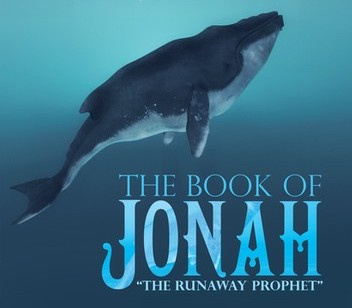
Introduction: The book of Jonah tells the story of the reluctant Prophet Jonah and his prophecy against Nineveh. Although best known for its big fish story, the real big story of the book of Jonah is its big revival story. The book tells us about the greatest revival in the Bible, and how it surprisingly occurred among a pagan people rather than among God's chosen people.
Jonah 1:1-3 — What’s your Nineveh? What is it that you won’t do that God wants you to do? Is it forgive someone you have a grudge against, witness to someone you are burdened for, or carry out some ministry that God has called you to?
Our "Ninevehs" can nullify our usefulness to God!
Jonah 1:3a — Tarshish was not only in the opposite direction from Nineveh, which was in the east, but also about as far west as one could go towards the end of the earth in Jonah’s day. Therefore, Jonah didn’t just run from God, but ran as far from God as he could.
No matter how hard or far you run there is no getting away from an omnipresent God who is ever-present everywhere.
Jonah 1:3, 15, 17 — Notice, when Jonah was running from God he went down to Joppa, down into a ship, down into the sea, and down into the belly of a whale. The moral of this story is obvious, the only way you can go when you're running from God is down.
Although some argue that the book of Jonah doesn’t say that Jonah was swallowed by a whale, but by “a great fish,” Jesus said, “For as Jonah was three days and three nights in the whale’s belly, so shall the Son of man be three days and three nights in the heart of the earth.” (Matthew 12:40)
Jonah 1:4 — The book of Jonah teaches us the intricacies of divine sovereignty. God uses wind (Jonah 1:4; 4:8), a whale (Jonah 1:17), a gourd (Jonah 4:6), and even a worm (Jonah 4:7) to do whatever He pleases (Jonah 1:14). None of it was coincidence, all of it was Providence!
“If there is one maverick molecule in the universe running around loose, totally free of God’s control, then God is not sovereign. And if God is not sovereign He is not God.” (R.C. Sproul)
Jonah 1:5-6 — While the storm was raging and the pagan shipmaster and mariners were frantically tossing over the payload and tossing up prayers on the deck of the ship, God’s reluctant prophet was fast asleep in the ship’s hull.
Not only did Jonah sleep while his ship was in danger of sinking into the storm-tossed sea, but King Saul slept while his assumed adversary David slipped into his camp and stole his spear and cruse of water (1 Samuel 26:5-12), Sisera slept while Jael drove a tent peg through his temples (Judges 4:17-22), Samson slept while Delilah cut his hair and robbed him of his strength (Judges 16:18-19), and the disciples slept while our Lord’s enemies came upon Him like a wolf pack in the night (Matthew 26:43-47). Still, in spite of the perilousness of ill-timed sleep, the contemporary church is plagued, in these perilous times of the last days, with a pandemic of spiritual sleeping sickness. Both its pulpits and its pews are filled with spiritual “sleepers,” regular “Rip Van Wrinkles” and “Sleeping Beauties.”
Jonah 1:7 — Convinced that the storm was supernatural, and that their jettison of the cargo and cried out prayers would not save them, the experienced sailors resorted to casting lots to locate the culprit to blame for endangering the lives of everyone on board.
It was no coincidence, but Divine Providence, that caused the lot to fall upon Jonah. (Proverbs 16:33)
Jonah 1:8 — The sailors wanted to know who in the world Jonah was and what in the world he had ever done to have caused such a storm and to have endangered the ship, along with the lives of everyone on board.
Sin, as Jonah definitely learned, is never concealable, it will always find us out (Numbers 32:23). Furthermore, it is never inconsequential, neither to ourselves nor to others.
Jonah 1:9-10 — The question the prophet was asked—“Why hast thou done this?”—is indicative of the astonishment of those who asked it. They understood how a faithless pagan would run from the Lord, but they were flabbergasted that a God-fearing prophet would ever do so.
It is truly inconceivable and unconscionable that a prophet should become a prodigal, forsaking his Father’s house for the far country.
Jonah 1:11-12 — The only hope for a storm-tossed ship caught in a tempest over some sin on board is to throw the sin overboard.
As Israel learned with Achan, and the mariners learned with Jonah, as long as there is sin in the camp or on deck, the soldiers will be defeated and the sailors drowned. The only remedy for defeat or rescue from drowning is to rid the camp or ship of the sin. (Joshua 7:1-26)
Jonah 1:13 — No matter how hard you strain at the oars you will never get anywhere with sin on board.
Just as nothing can be against you if God is with you, nothing can help you if God is against you. (Romans 8:31)
Jonah 1:14-15 — The instant sin was cast overboard the sea was calmed and the ship was saved, proving to the sailors that the storm came from a sovereign Jehovah and was caused by the sinful Jonah.
As the sailors were saved by the sacrifice of another, the sinful Jonah, who voluntarily agreed to be cast into the sea for his own sin, we are saved by the sacrifice of another, the sinless Jesus, who voluntarily agreed to be crucified on Calvary for our sins. (John 10:17-18)
Jonah 1:16 — The sailors were like the disciples, in that their fear of the storm was instantly changed, upon the storm’s sudden subsiding, into the fear of God, who not only controls the storm, but calms the sea. (Mark 4:36-41)
No matter the god or gods the pagan sailors previously prayed to in their panic, they ended up praising and pledging themselves to the God of Jonah, persuaded that He alone was worthy of their worship.
Jonah 1:17 — The great fish, just like the gourd, the worm, and the east wind of the book of Jonah, were all “prepared” or appointed by Divine Providence to be used as God pleased in the bringing to pass of His plans and purposes. (Jonah 4:6-7)
A school teacher tells his students that it is physically impossible for a whale to swallow a human being. One of his students objects, however, insisting that the Bible teaches that Jonah was swallowed by a whale. The teacher then asked the student how he can prove the Bible is true, to which the little boy replies, “Well, when I get to Heaven, I’ll ask Jonah about it.” The sly teacher craftily retorts, “What if Jonah isn’t in Heaven, but in Hell.” “Then,” the little boy responds, “you can ask him.”