Header Graphic
TIME FOR TRUTH
The Home of The Tweeted Bible
JOEL
Tweeting Through Joel

Introduction: The book of Joel is not only the earliest book of the minor prophets, but possibly the earliest book of all the Old Testament prophets. Joel introduces us to “the day of the Lord,” an expression strewn throughout the pages of sacred Scripture. The expression normally points to some pending judgment on a particular people at a particular time that foreshadows the consummate “day of the Lord,” which is God’s ultimate judgment of all people at the end of time.

Joel 1:1 — The word of the Lord came to Joel, as it does to all of God’s prophets. 


True prophets do not come up with God’s Word, but God’s Word comes to them!


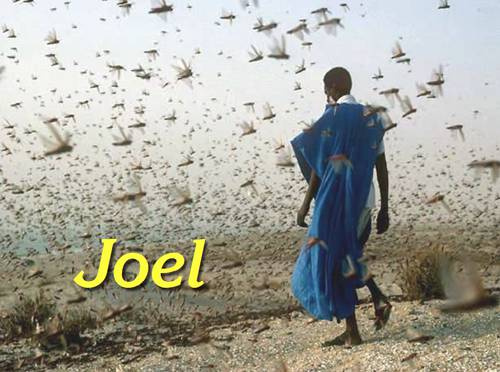
 Joel 1:2-4 — In these verses Joel is either predicting an upcoming plague of locusts that was about to happen or describing an occurring plague of locust that was happening. 


Whether Joel is predicting an ominous upcoming plague of locusts or describing an occurring one, it was to be spoken of throughout future generations as unlike anything seen by former generations.  


READ DUAL PROPHECY


Joel 1:5-7 — Joel calls upon the drunkards to awaken out of their drunken stupor to the sober sight that all the grapevines were stripped and wasted and all the branches of the fig trees were stripped and white. 


Since both the vine and the fig tree were symbols of God’s people, we may also understand these verses to be a call for a sinfully soused Judah to spiritually awake to the sober sight of its spiritual desolation.


Joel 1:8 — Joel calls upon Judah to mourn like a young widow, not just over their land being laid waste, but also over their wrongdoing, which led to Judah becoming a wasteland. 


A truly penitent sinner is sorry for committing sin, not just for the consequences of sin.


Joel 1:9-10 (HCSB Holman Christian Standard Bible) — Joel calls upon the priests to mourn, because the drink offerings and grain offerings were cut off from the house of God over the destruction of Judah’s vineyards and grain fields. (Joel 1:13 HCSB)


Notice, there was no cessation of religious ceremony during Judah’s rebellion against God, but only after divine retribution fell upon Judah, proving that the unrepentant are not necessarily unreligious. 


Joel 1:11-12 — Joel calls upon the husbandmen and the vinedressers to be ashamed over both the fruit of their labor being destroyed and the joy of the harvest being deprived from the sons of men.


We should not only be ashamed over the futility and fruitlessness of the works of our sinful hands, but also over our sin, our falling so far short of God’s glory, which turns our fallen endeavors into exercises in futility. (Romans 3:23)


Joel 1:13 (HCSB Holman Christian Standard Bible)— Joel calls upon the priests to mourn, because the drink offerings and grain offerings were cut off from the house of God over the destruction of Judah’s vineyards and grain fields. (Joel 1:9-10 HCSB)


Notice, there was no cessation of religious ceremony during Judah’s rebellion against God, but only after divine retribution fell upon Judah, proving that the unrepentant are not necessarily unreligious. 


Joel 1:14 — Calamities, which serve as harbingers of impending judgment upon a country, should be seen by God’s children as a call for a solemn assembly; that is, as a serious call to repentance, in hopes of securing a divine reprieve from swiftly approaching divine retribution. 


If the church had called for more solemn assemblies our country would have never gotten into such a sad state of affairs. 


Joel 1:15 — The day of the Lord—a pending judgment on a particular people at a particular time, which points to the ultimate judgment of all people at the end of time—was first declared by the Prophet Joel, who made it the theme of his prophecy. (Joel 2:1, 11, 31; 3:14, 18)


It was the Prophet Joel who introduced us to “the day of the Lord,” an expression strewn throughout the pages of sacred Scripture, which warns us all of God's impending judgment of us and of our inescapable accountability and answerability to Him.


READ THE DAY OF THE LORD


Joel 1:16-18 — The utter destruction of the upcoming day of the Lord is described in these verses most dauntingly. 


Food would disappear from tables and festivals from the temple. The seed would die in the dried up soil and the stored grain would disappear from the depleted granaries. Even the flocks and the herds would bleat, low, and mourn over their ruined ranges and parched pastures. 


Joel 1:19-20 — To wait until the day of the Lord to cry out to the Lord, and even then, to cry out over your hunger and thirst, not over your trespasses, is to howl and growl like wild breasts over dried up rivers and ranges.


If you wait till the day of the Lord to cry out to the Lord, you will have waited too long. Today, not the day of the Lord, is the day of salvation, and now, not later, is the acceptable time for you to call upon the name of the Lord and to acquaint yourself with the Lord. (Job 22:21; Romans 10: 12; 2 Corinthians 6:2; Hebrews 3:15)  


Joel 2:1-17 — Joel's prophecy had a later and symbolic fulfillment in an invading enemy army—the Judah conquering Chaldeans. 


Joel 1:6-2:11 — Joel's prophecy will have an ultimate and spiritual fulfillment in a demonic invasion of the whole earth. (see also Revelation 9:1-12)


Joel 2:12-13 — It is the rending of repentant hearts that God requires, not the rending of religious raiments. 


Joel 2:18-3:21 — God pours out His Spirit on all who decide to receive His Son, but sits in judgment on all who decide to reject His Son. 


BACK TO TWEETS BY THE BOOKS
